%20-%20120%20x%2044.svg)
Pre-appointment automations help your practice send the right information to clients before an appointment, based on the conditions you choose. You can use them to send targeted appointment reminders for specific appointment types, services, locations, practitioners, appointment flags, client types, or telehealth appointments.
They are also useful for sending preparation instructions, intake form links, appointment-specific details, telehealth information, location guidance, payment links, or other helpful information before a client attends their session.
You can also use pre-appointment automations to create internal tasks for your team before an appointment. For example, you might create a task to prepare paperwork, check client details, review an intake form, or follow up on information needed before an initial consultation.
Pre-appointment automations are especially useful when different appointments need different reminders or communication. For example, you can send one reminder for initial consultations, another for telehealth appointments, and another for appointments at a specific location or with a specific practitioner. This also means that you can disable reminders for some appointment types. If they don't meet the automation conditions, the reminder messages triggered by automations won't send.
You can set up targeted messages based on conditions such as days before the appointment, appointment location, appointment status, service, appointment flag, client status, practitioner, client type, client classification, or whether telehealth is enabled.
Use this article to set up automated pre-appointment emails, SMS messages, and tasks for targeted appointment reminders, appointment preparation, client instructions, intake follow-up, telehealth appointments, first appointments, practitioner-specific workflows, location-specific reminders, service-specific reminders, and other pre-session communication.
Pre-appointment automations are processed every day at 2:00 PM (14:00) local time for each account for eligible appointments.
In this article:
- Using Pre-Appointment Automations For Sending Communication Before An Appointment
- Why a Pre-Appointment Automation Might Not Be Sent
- What Happens When an Appointment Is Rescheduled
- When the Send Day Falls on a Weekend
- Sending All Automation Communication to Clients' Contacts
- Example Use Cases
- Related Articles
Using Pre-Appointment Automations For Sending Communication Before An Appointment
Such automations are set in User Menu > Account Settings > Communication > Automations:
- Once on the automation settings page, click '+ ADD AUTOMATION':
- Enter automation name and select the automation type: 'Pre-appointment':
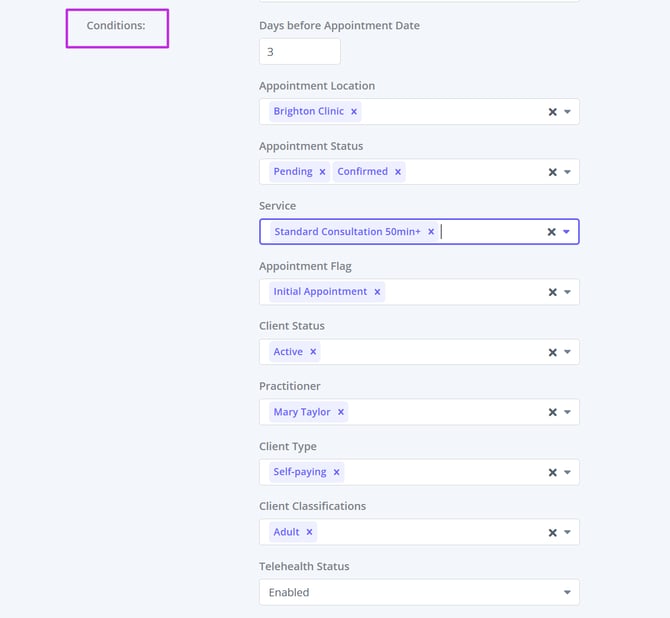
the available Conditions dropdowns to set the conditions for this particular automation. The available conditions for the pre-appointment automations are:
- Days before appointment date (you can select starting from 1 day before the appointment date)
- Appointment Location (you can select multiple locations for the same automation)
- Appointment Status (you can select multiple statuses for the same automation. (Tip💡Select Pending and Confirmed if you want the automation to trigger only for active upcoming appointments.)
- Service (you can select multiple services for the same automation)
- Appointment Flag (you can select multiple flags for the same automation)
- Client Status (you can select multiple client statuses for the same automation)
- Practitioner (you can select multiple appointment practitioners for the same automation)
- Client Type (you can select multiple client types for the same automation)
- Client Classifications (you can select multiple client classifications for the same automation)
- Telehealth Status (refers to appointments with telehealth links on or off, select All, Enabled or Disabled)
⚖️ How Matching Works
-
Within a single condition (for example, selecting multiple Locations or multiple Client Classifications), the system applies OR logic. Example: If you select Melbourne and Sydney, the automation will trigger if the appointment is in either Melbourne or Sydney.
-
Across different conditions (for example, Location + Practitioner + Service), the system applies AND logic. Example: The automation will trigger only if the appointment is in Melbourne AND with Practitioner Dr. Lee AND for Service Initial Consultation.
| Logic Type | Example | Result |
|---|---|---|
| OR (within one condition) | Appointment Location = Melbourne OR Sydney | Triggers if the appointment is at either location |
| AND (across conditions) | Location = Melbourne AND Practitioner = Dr. Lee AND Service = Initial Consultation | Triggers only if all match |
💡 Tip: Multiple selections inside one condition = OR, while multiple conditions together = AND.
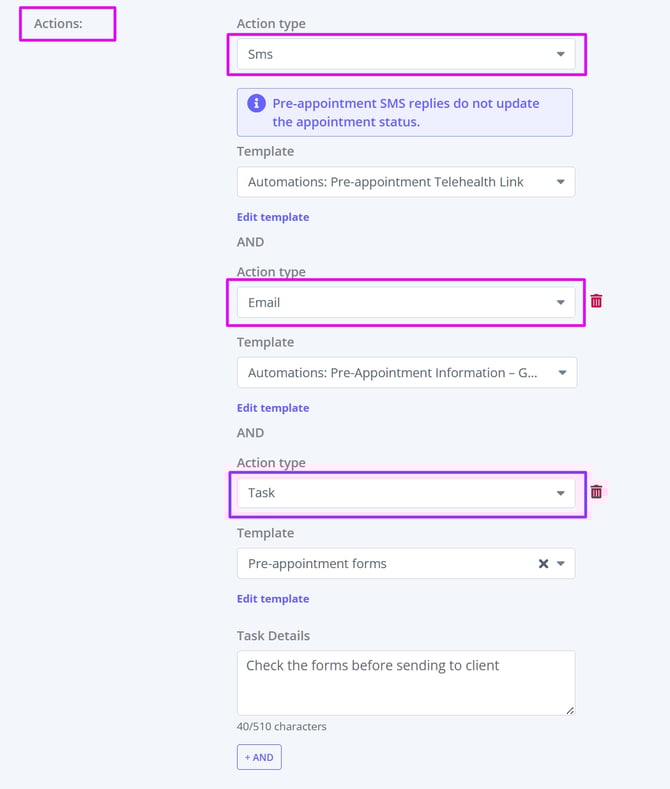
4. Now, select the action type: Email, SMS* or Task
5. Select a communication template to be used with each action you selected for this automation. If you do not have a suitable template, create it in Tools > Communication > Templates or copy them here.
Important note about appointment reminders
Pre-appointment SMS actions can be used for targeted or specialized appointment reminders, such as reminders for a specific service, location, practitioner, appointment flag, client type, or telehealth appointment.
They are different from standard appointment reminders and do not include reminder-specific features such as failed-send retry attempts, AM/PM delivery scheduling, or automated reply handling to update appointment statuses.
For general attendance reminders that apply broadly across appointments, use standard appointment reminders. For customized reminders or additional appointment-specific messages, use pre-appointment automations.
6. Click 'AND' to add more actions if needed.
7. If you selected a Task action, in addition to selecting a communication template, you can also add an internal note for your team in the Task Details field. The automation task will appear in your main Tasks dashboard with no assigned user, so it shows as Anyone. Who can see it depends on each user's task permissions and their client profile access. For details on who can see tasks and how to assign one, see Using Client and Practice Tasks.
8. Save the changes.
💡 Tip:
- You will be able to set up more automations to cater for different practitioner needs and other use cases.
- If a communication template includes invoice merge fields—such as
{InvoicePayLink},{InvoicePDFLink}, or{InvoicePDFAttachment}—and the appointment has a linked invoice, the pre-appointment automated message will include the invoice in the format specified by the merge field used.
Why a Pre-Appointment Automation Might Not Be Sent
Pre-appointment automations are processed once a day, at 2:00 PM (14:00) in your account's local time. Each daily run looks for appointments whose date is exactly the number of days ahead you set in Days before appointment date. If a client didn't receive their message, work through the checks below in order.
1. Confirm whether the message was sent
Start here, because it tells you whether the automation didn't trigger at all or triggered and the message failed:
- Open the client's profile > Communication > Activity for a record of every message sent to that client, including automated ones.
- Or run Reports > Practice > Email Activity to list the emails your account generated and their status (pending, sent, or failed).
2. Check when the appointment was created
The automation has one trigger day: the appointment date minus the number of days you set. If the appointment was created after that day's 2:00 PM run, the trigger day was already gone and no message is sent.
Example: your automation sends 4 days before the appointment, but the appointment is booked 2 days beforehand. The trigger day has passed, so the message isn't sent. An appointment created on the trigger day itself, but after 2:00 PM, is missed for the same reason.
This helps make sure clients don't receive reminders or forms too late to act on them.
💡 Tip: Think about how far in advance your clients usually book, and set Days before appointment date to suit
3. Check the automation is active
In User Menu > Account Settings > Communication > Automations, confirm the automation is switched on. The daily run only picks up active automations, so a deactivated one is skipped until you reactivate it.
4. Check the appointment meets every condition
All the conditions on an automation are combined with AND logic, and they're read at 2:00 PM on the trigger day. A single mismatch at that moment stops the message, and a change made afterwards doesn't re-trigger it. Three conditions are worth checking closely:
- Telehealth Status = Enabled. The telehealth link has to be switched on for that specific appointment, not just for the location. An appointment created before telehealth was enabled on its location keeps the setting it was created with, so it can miss an automation that other appointments at the same location match. To switch it on for existing future appointments, see Enabling Telehealth Calls on Appointments Automatically. For a group appointment, the telehealth link sits on the group rather than on each client's place in it.
- Service. The Service condition is matched against the service on the appointment's linked invoice. If the appointment has no invoice yet, or its invoice doesn't include the service you selected, the appointment won't match a Service-based automation. If you want the automation to run regardless of invoicing, leave the Service condition unset.
- Appointment Status, Appointment Flag, Practitioner, Appointment Location, Client Type, Client Status, and Client Classification. Each one has to match on the trigger day. A status still set to a value you didn't select, or a client classification added later, is enough to skip the message.
5. Check the appointment and the client record
Deleted appointments are excluded from pre-appointment automations, and so are archived clients.
6. Check the client's contact details
An automation can match perfectly and still have nothing to send to:
- An Email action needs a valid email address on the client's profile.
- An SMS action isn't sent to a client who has opted out of SMS. See Managing SMS Communication Preferences.
Sending the message now
If the trigger day has passed, you can still send the message by hand. Open the appointment and use Notify Now to send a reminder, or the telehealth link for a telehealth appointment. See Sending Appointment Reminders Manually.
What Happens When an Appointment Is Rescheduled
Pre-appointment automations are not triggered by creating or editing an appointment. Each daily 2:00 PM run looks at each appointment's current date, so when an appointment moves, its trigger day moves with it.
If the new trigger day is still ahead , the appointment is picked up again on that day and the message is sent again. Zanda doesn't keep a record of a pre-appointment message already having gone out for an appointment, so a client can receive the same intake form, preparation instructions, or payment link a second time. This applies however the appointment was moved: by your team on the calendar or the appointment panel, or by the client through the Client Portal.
If the new trigger day has already passed , no message is sent for the new date. Send it by hand using Notify Now , as described in Sending the message now above.
Post-appointment and recall automations follow the same pattern, because they also match on the appointment date.
New Client automations are the exception. They match on the date the client's profile was created, not on any appointment, so no appointment change re-triggers them. A client who has already received a welcome or onboarding message won't receive it again because their appointment moved.
Stopping a repeat message on a rescheduled appointment
Changing an appointment's status to Rescheduled does not on its own stop a pre-appointment automation. If the Appointment Status condition is left unset, the automation matches an appointment in any status.
To control this, give the automation an Appointment Status condition listing only the statuses you want it to send for, for example Pending and Confirmed. Conditions are read at 2:00 PM on the trigger day, so an appointment in any other status at that moment is skipped. Appointment Flag works the same way: remove the flag from the moved appointment and it no longer matches a flag-based automation.
If an automation has no condition you can use this way, the message will send again on the new trigger day.
Standard appointment reminders behave similarly. When your team moves an appointment's start to a date and time in the future, Zanda clears its record of the reminder already sent, so an automatic reminder is scheduled again for the new time. See Configuring Appointment Reminders.
When the send day falls on a weekend
Pre-appointment automations count calendar days, not business days. When you set an automation to send a set number of days before the appointment, Zanda counts every day, including Saturdays and Sundays, back from the appointment date. For example, a 2-day pre-appointment automation for a Monday appointment sends on the Saturday, and for a Tuesday appointment sends on the Sunday.
The Days before appointment date condition is the only timing control, and it always counts calendar days. There is no setting to skip weekends, switch to business days, or move the send to the prior Friday.
If you would prefer clients not receive messages on a weekend, choose a day count that lands the send on a weekday for your most common appointment days. Avoid setting up several overlapping automations with different day counts to catch weekend cases: no weekend rule stops more than one of them from sending, so the same client can receive duplicate messages. This timing behavior also applies to invoice messages sent through pre-appointment automations, for example templates that use invoice merge fields.
Sending All Automation Communication to Clients' Contacts
You can send automations communications, such as pre-appointment messages, follow-ups, invoices reminders, recalls and so on, directly to a client’s contact.
How It Works
- Open the relevant client Profile > Contacts tab and select their connected contact, or add the contact who will be receiving their automation communication messages.
- Each connected contact profile includes a Send all automation communication toggle. You’ll find this setting just below the Send reminders toggle in the connected contact’s settings. Turn this toggle on.
- Save the changes. When this option is turned on, all automated messages that would normally go to the client will also be sent to that contact. This includes any automations triggered by reminders, invoices, recalls, or similar workflows.
Example
If a parent, guardian, or carer is listed as a contact and the Send all automation communication option is enabled, they will receive the same automated messages as the client.
💡 Tip:
Before enabling this setting, make sure you have the contact’s consent to receive communications on behalf of the client. This helps maintain privacy and ensures compliance with communication and data protection standards.
Example Use Cases
Custom reminder for initial consultations
If you’d like to send a tailored message—such as what to bring, intake forms, or what to expect—only for first-time appointments, you can set up a targeted automation:
- Create a Pre-appointment Automation
- Set the condition: Appointment Flag = Initial Appointment
- Select your custom template as the action
This ensures the message is sent only to appointments with the Initial Appointment flag, while all other reminders continue as usual—no manual tracking required.
💡 Tip: This is a great way to personalise the onboarding experience for new clients without adding extra admin work for your team.
Related Articles
- Managing Automations - Activate, deactivate, and edit automations, and see when each type is processed.
- Automations FAQs - Confirm whether an automated message was sent, and how archived clients are treated.
- Sending Appointment Reminders Manually - Use Notify Now to send a reminder or telehealth link when the trigger day has passed.
- Enabling Telehealth Calls on Appointments Automatically - Switch telehealth on for a location and for existing future appointments.
- Managing SMS Communication Preferences - Check and update a client's SMS opt-in status.