%20-%20120%20x%2044.svg)
If youuse a third-party service to send electronic faxes via email, you can set it up to receive emails sent from Zanda. This is an email-to-fax workflow, not a direct connection between your Zanda account and your eFax provider account. When emails are sent via our mail servers the practice's 'From' name and 'Reply-To' email addresses are used.
In this article:
- Sending eFaxes via Email Through GoFax
- Locating Your Zanda From Email for Other eFax Services
- Frequently Asked Questions
Sending Electronic Faxes from Zanda via GoFax
Note 💡 GoFax Service Availability and International Sending
- GoFax currently offers services to Australian domestic customers or businesses with an Australian presence. Retail account sign-up requires an Australian phone number.
- While GoFax supports international fax sending, successful delivery depends on the receiving country’s carrier networks and any restrictions they apply to manage spam.
- The United Kingdom and New Zealand are two of GoFax’s core destinations where fax delivery is generally reliable. Please note that this may change if local carrier policies are updated.
- For North American customers, GoFax’s sister company Notifyre provides local infrastructure and services in the United States. You can learn more here.
- For step-by-step guidance, refer to the GoFax support article: How to send a fax from email
1. Once you have set up a GoFax account and added ‘Send’ credits, you will need to ensure that your email address is set up as an allowed sender in GoFax. See: Manage Allowed Senders For Fax to set up your email address as an allowed sender in GoFax.
2. Locate your allowed sender email address in Zanda:
- Log in to your Zanda account
- Navigate to User Menu > Account Settings > Communication > Communication Options
- Copy the email address in the Business Email Address field. This email address must be added to your GoFax account as an allowed sender.
3. Set up a client or a referrer profile to send a file as fax. To send a fax from Zanda, you need to ensure the client or referrer’s fax number is added to their contact record as their email address.
- Locate the client or referrer profile via the People > Clients or People > Referrers menu on the left, or the main search bar at the top of the Zanda screen
- In the Email field: enter the recipient email address as faxnumber@send.gofax.com.au Be sure to include the area code with no space. For example 0388889998@send.gofax.com.au)
- Save Changes
4. Once done, you will be able to send letters to referrers from client profiles as efaxes. For detailed information on this process, please refer to this article about Sending Letters to Referrers.
5. It is also possible to send files uploaded to client profiles as faxes to clients or their referrers.
- Once the file has been uploaded to Zanda, click the cogwheel next to the file you wish to send as fax under Actions
- Select Email
- Select the recipient’s details at the top of the page and the body of the email to fax.
- Click Send Email and the file will be sent as an email to fax via GoFax
-
Repeat the above steps for each file you need to send via e-fax.
Note💡It is possible to efax an email without an attachment via your GoFax account. To do so, please add /b to the email subject line.
Locating your Zanda From Email for Other eFax Services
A unique Zanda 'sending' address is also used for each practice. This helps maximise email delivery and therefore your emails are less likely to be marked as Spam.
Normally this happens behind the scenes and there is no detectable impact for practices or email recipients. Third-party eFax systems, however, detect the difference because they are utilising the underlying sending email address to validate and match to your eFax account. To address this you need to add your unique sending email address to your eFax accounts list of accepted 'From' addresses;
- Identify your 'From' email address by sending yourself an email from your Zanda account or contact us at support@zandahealth.com.
- When you get the email click to expand the sender information. You should see the email address and be able to copy it.
Hint 💡It should look something like the below: <emailout+@zandahealth.com>

3. Log in to your third-party faxing account and paste this email address to your permitted 'From' or 'Sending' addresses.
Frequently Asked Questions
❓ Can I link my GoFax account directly to Zanda?
No. Zanda does not link directly to your GoFax account. To send faxes with GoFax, set up GoFax to accept emails from your Zanda sender address, add the recipient's GoFax email address to the client or referrer profile, and then send the letter or uploaded file from Zanda by email.
❓ If I add a CC recipient, do they also receive a copy when I send a fax via GoFax?
Yes. Sending a fax via GoFax is an email-to-fax workflow, so any CC recipient you add to the communication receives a copy of the email—the same message and attachment—just like a normal Zanda email. Only the primary recipient, whose email address is set to a GoFax fax address (for example 0388889998@send.gofax.com.au), has their copy converted into an actual fax by GoFax. A CC recipient receives the email version, not a fax—unless the CC address is itself a GoFax fax address.
❓Am I able to send faxes from Zanda with eFax.com?
- This is possible if you use your custom SMTP server to send emails from Zanda.
- eFax.com does not support From addresses that contain some symbols, such as +, therefore they do not support the unique Zanda addresses, so it is not possible to send faxes via eFax.com using Zanda SMTP server.
❓ Can I store both a normal email address and an eFax address for the same referrer?
Not as two sendable addresses. A client, referrer, or Third Party profile has a single Email field, and every email Zanda sends—individual messages, letters, and Bulk Send—uses that one address. Because eFaxing works by emailing the fax address, setting a profile up for eFax means the eFax address occupies the Email field, so that profile will no longer receive ordinary email from Zanda.
A few things worth knowing:
- Referrer and Third Party profiles also have a Fax field, directly above the Email field. This field is for reference only—it appears on printed invoice headers and is not used to send anything, so putting a fax number there will not send a fax.
- You can record the referrer's other address in a custom field so your team can see it on the profile. A custom field can be pulled into the body of a message as a merge field, and it is not available as the recipient address.
- If a referrer needs both, one option is to keep two profiles: one holding the eFax address for faxing letters and documents, and one holding the normal email address for everything else. Zanda does not link the two, so take care to keep their details consistent.
❓ How do I send a bulk email to referrers without also faxing the ones set up for eFax?
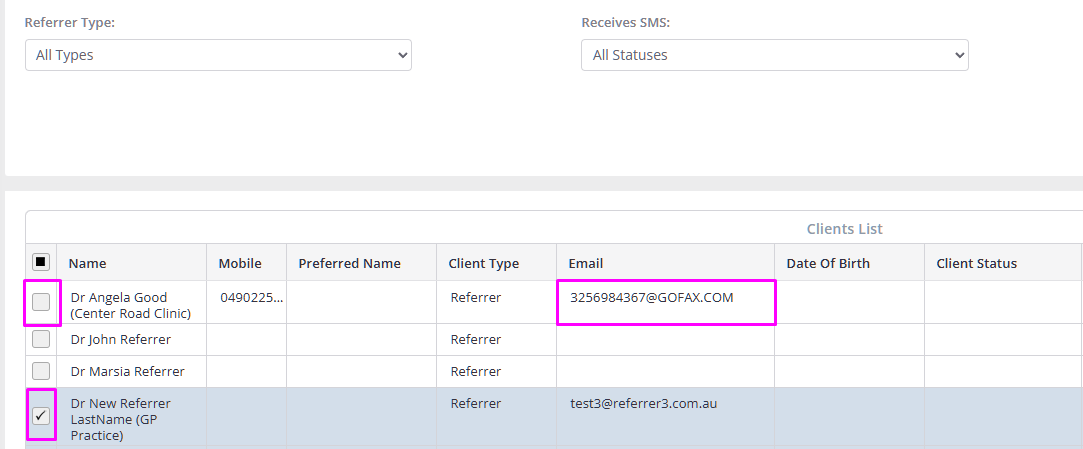
Bulk Send delivers email and SMS only, so there is no bulk fax to switch off—the goal is simply to leave the eFax-address referrers out of the recipient list. Do that on the Add Recipients screen:
- Go to Tools > Communication > Bulk Send and choose your email template.
- Click Add Recipients to open the advanced search filters.
- Narrow the list using Referrer Type if your eFax referrers sit in a type of their own. Classifications are not available when you are searching referrers, so if Referrer Type does not separate them you will be working from the full list at the next step.
- Click Get Clients to generate the list, then untick any remaining eFax-address referrers before sending. The list shows each profile's email address, so the fax addresses (for example, those ending in
@send.gofax.com.au) are easy to spot.
💡 The Email filter on this screen matches any part of an email address, so you can use it to find your eFax referrers (search for gofax) and confirm which profiles to exclude. It matches profiles rather than excluding them, so use it to check your list rather than to build it.